

The SP Method enables our students to be prepared and confident before entering the testing room.
 Time is your most limited resource on any standardized test. It is critical to optimize your confidence and problem-solving skills before test day.
Students are ready to excel at the test because of the Strategies and Problem-solving techniques they learn in our courses. The SP Method equips students with techniques they need to ace the math sections of standardized tests.
“S” is for Strategies
After undergoing a comprehensive Math foundation review, our students learn critical Strategies that are essential to their success on standardized tests. The first part of the SP Method stresses general test-taking tips to increase students’ confidence and focus. In addition to foundational concepts and timesaving shortcuts, MathSP courses emphasize problem-solving strategies. The difference between a student with a good test score and a student with a great test score is the ability to appropriately apply Strategies to quickly “zero in” on the correct answer.
The Strategies component of the SP Method takes students through a five-step process to approaching Math problems.
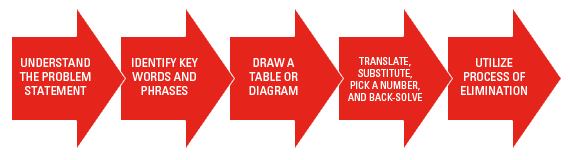
Understand the Problem Statement
Many students do poorly on standardized tests because they don’t understand the problem statements. We teach our students how to quickly answer the following key questions BEFORE attempting to solve the problem:
- What are you asked to find?
- What information do you have?
- What concepts do you need to understand in order to find the solution?
Identify Key Words and Phrases
Most problems are comprised of unnecessary details. Students will learn how to identify key words and phrases and translate those words and phrases into mathematical equations.
Draw a Table or Diagram
Get ORGANIZED. Our students learn how to organize the question’s content into a table, diagram, or other figure in order to better understand the problem. The question should make sense visually so that it is easier to find the correct solution.
Translate, Substitute, Pick A Number, and Back-Solve
Our students master and deploy some of the most dependable test-taking strategies such as translation and substitution as well as time-saving strategies such as back-solving and picking numbers in order to solve problems accurately and efficiently.
Utilize Process of Elimination
Students hone process of elimination techniques to save valuable time and increase the probability of choosing the correct answer.
“P” is for Problem-solving
The second component of the SP Method consists of extensive and repetitive Problem-solving. This allows students to apply the newly learned Strategies to real test questions. Students solve problems and are encouraged to explain their solutions through a Facilitative Approach to learning. By repeatedly working through knowledge-driven problems to reinforce concepts and strategies, students build their confidence and skill sets. Standardized tests assess students’ knowledge of a finite number of concepts – so the more problems they work through, the better they become at identifying concepts and parallels in problem types, and the higher their score will be.
The Problem-solving component of the SP Method includes:
Questions from Previous Tests
These allow students to practice solving real problems and to become familiar with concepts that they are likely to see on their test.
Course Material Arranged by Concept
Our specialized arrangement of course materials allows for repetition and familiarity with similar problems. This reinforces the strategies and concepts learned.
The Facilitative Approach to Learning
The Facilitative Approach ensures comprehension. Students work problems individually to gauge their understanding of specific concepts. Coaches time each problem so that students adapt to the time constraints they will experience on test day. Then coaches guide students through the most efficient solutions to each problem to enhance their understanding of the steps involved and to strengthen their problem-solving muscles.
Weekly Problem-solving Assignments
Regular assignments encourage mastery of strategies, concepts, and timing.